Why 1 in 4 Women Say They Feel Nothing During Intimacy..
With the Man They Love And Why It Has Nothing to Do With His Hygiene....
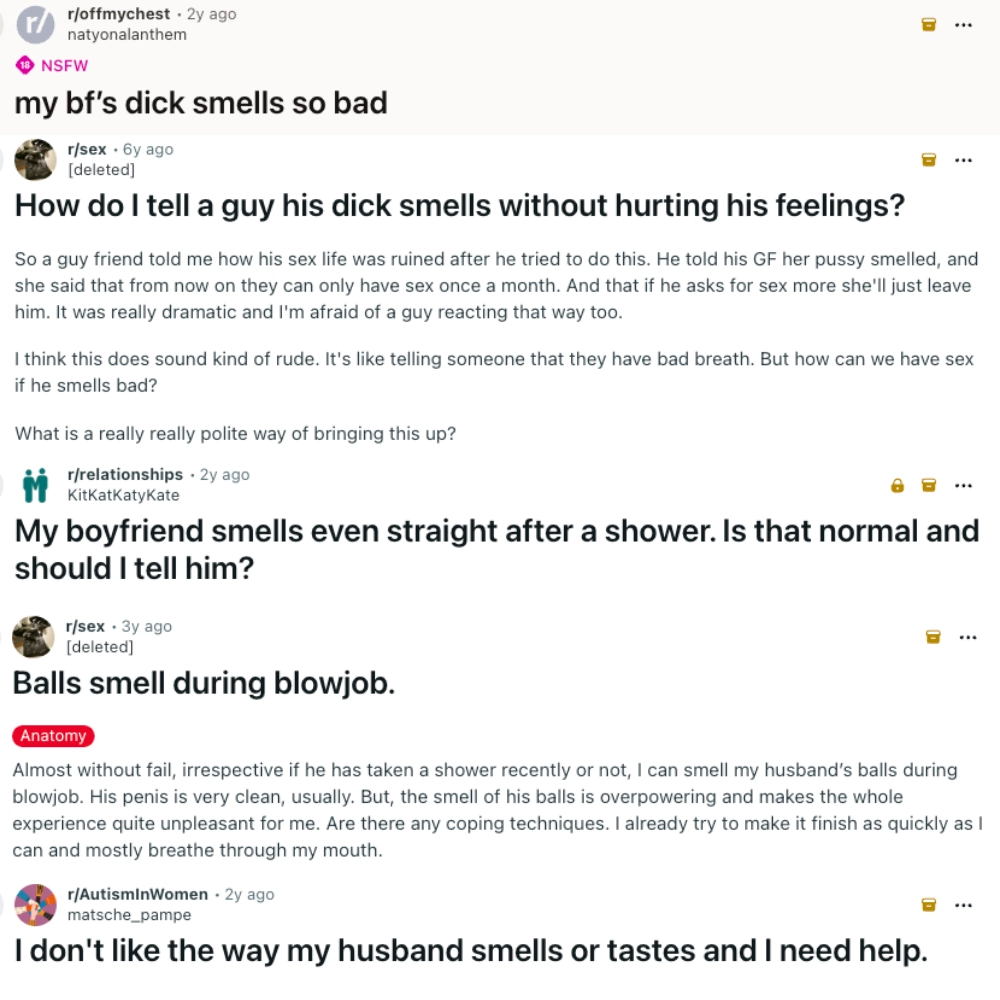
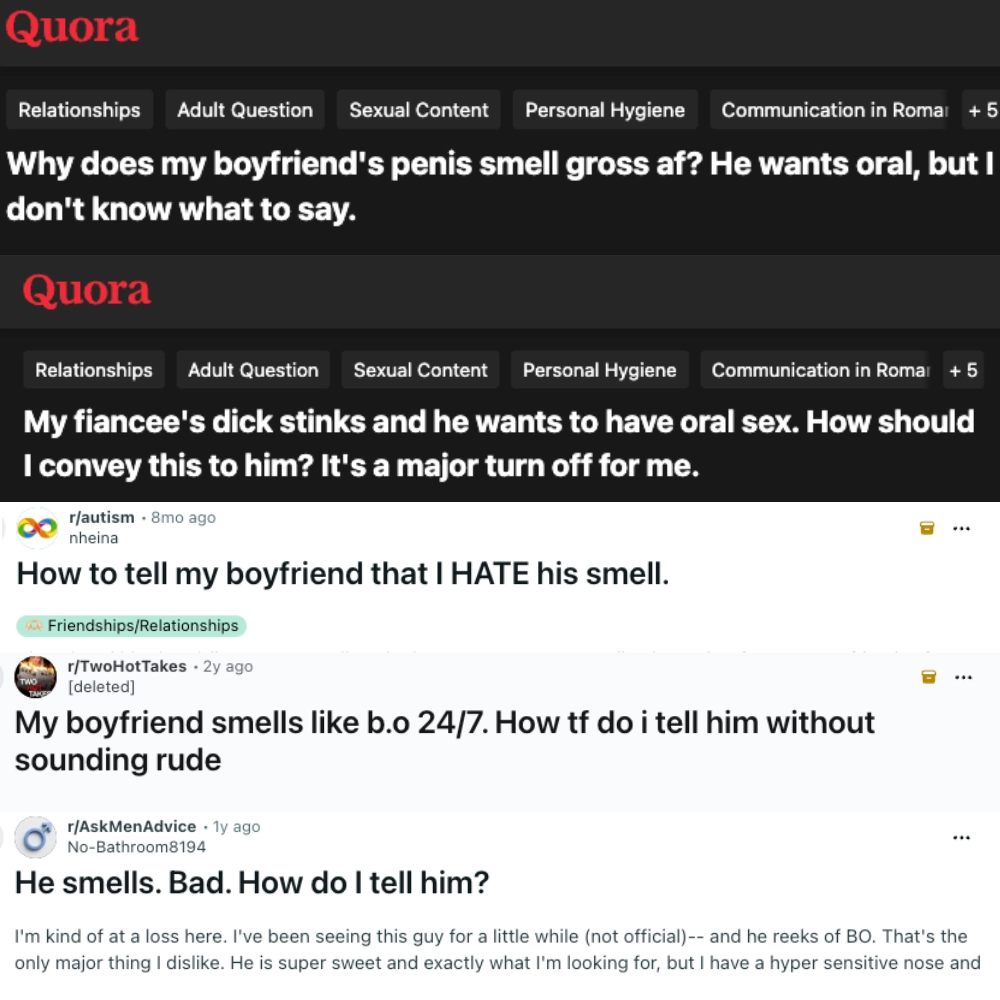
When I started this project, I expected to write about the orgasm gap. Everyone knows that number by now. I wanted to know the why behind it. So I did two things: I put a set of very direct, very private questions to 753 women in long-term relationships and I spent my nights where women actually talk. The 2am threads. The anonymous questions typed, deleted, and retyped.
I did not expect the answer that came back.
Because the women who told me they felt nothing not resentment, not boredom, just a flat, guilty blankness during the most intimate thing you can do for someone kept describing the same thing. Over and over. In almost the same words. It wasn't about technique. It wasn't about love most of them loved their partner desperately. That was the whole problem.
It was about a smell. And more precisely, about what causes it which almost none of them had right.
In our survey, 1 in 4 women said they get no real pleasure from being intimate with their partner. And a striking number pointed to the same quiet, unspoken reason. Then I went to the forums to see how widespread it really was. I stopped counting the threads somewhere past a hundred. Same story, different usernames.
This is what they told me. And this is what I found when I went looking for why.
"He smelled amazing when we met. Then something changed."
That sentence, or some version of it, came up more than any other in the survey and in the threads alike.
Not "he was always like this." The opposite. He smelled good at the start. On one forum, a woman asked it almost word for word: "He just smelled good on our first dates why now?" And notice what sits underneath that question. Not an accusation. Confusion. What changed? Was it something I did? Almost all of them assumed, at first, that it was somehow them.
Here is the shape of it, assembled from dozens of near-identical accounts:
She notices. It's faint, then it isn't. She tells herself it's nothing. Then it becomes the thing she thinks about when he reaches for her at night the little flinch of dread she hates herself for. One woman described her routine in a sentence I haven't been able to forget: "I already try to make it finish as quickly as I can and mostly breathe through my mouth." A routine. Rules. For being close to the man she loves.
And she says nothing. Because how do you tell the person you love that they smell, without something breaking that you can't put back? The single most repeated question across every forum I read typed thousands of times, almost never said out loud is this one: "How do I tell him without hurting his feelings?"
So she carries it alone instead. "I have no one to tell this to," one woman wrote at 2am. Another had been married fourteen years before she could say it anywhere at all and she said it to strangers on the internet, not to him: "I don't like the way my husband smells or tastes and I am scared to talk about it." Fourteen years.
And still and this is the part that tells you who these women really are they defend him. "My friends say I should break up with him," one wrote, "but I think it's silly." She doesn't want out. She wants him back. The him from the first dates.
If any of that landed a little too close, I need you to hear the next part. Because it changes everything, and it's the part that took me months of research to fully understand.
What almost every one of them got wrong
Nearly every woman who described this to me assumed the same cause: he isn't washing enough.
It's the obvious conclusion. It's also, in almost every case, wrong and I can prove it with the one detail that showed up again and again, in the survey and across the threads.
He showered. He showered a lot. "Showers everyday, sometimes twice a day." "Straight after the gym, every time." "He's honestly cleaner than I am." And still within an hour, sometimes less it was back.
That detail is the whole key. Because if washing worked, washing twice would work twice as well. It doesn't. And the reason it doesn't is something dermatologists understand well and almost nobody else does.
Here is what's actually happening.
Fresh sweat has no smell. None. The sweat from the glands in the groin the apocrine glands, the same type you have in your armpits comes out completely odorless. Chemically, it's nothing. It cannot offend anyone.
The smell is made afterward, by ordinary skin bacteria breaking that sweat down into sharp-smelling compounds. That is not dirt. It is not a failure of hygiene. It's a normal biological reaction and it needs exactly three conditions to run: warmth, moisture, and no airflow.
Now think about where all three of those live, pressed against him, all day, every day.
His underwear. Fabric seals his own body heat against the skin. It traps the moisture instead of letting it evaporate. It cuts off the air. He is, without knowing it, wearing a small, warm, sealed box over the exact patch of skin densest in these glands and inside that box, bacteria don't multiply slowly. They multiply exponentially as the hours pass and the heat builds.
A shower empties the box for a few minutes. Then he gets dressed, and the box starts refilling immediately. By lunch, it's full again. This is why he can be spotlessly clean and still carry the smell an hour later. The shower rinses the surface. The box rebuilds it.
There's a name for this specific mechanism the heat with nowhere to go, sealed against the skin for fourteen hours a day. It's called Sealed Hyperthermia. And the moment it clicks, two things become clear at once.
It's not him. It's not you. It's what he's wearing.
It was never about him at all. And you weren't cruel, or broken, or a bad partner for feeling what you felt. Two people who love each other, both quietly blaming themselves for something that was, the entire time, a sealed box doing exactly what a sealed box does.
"So just change his underwear, right?"
I thought that too. It's the natural next thought, and it deserves a straight answer, because it's a trap.
A different fabric helps a little, at the edges. But he is not going to spend his day with nothing on. He puts a box back on either way every man does, all day, at work, in the car, at the gym. So the material was never the decisive question. The decisive question is what happens inside the box during the hours he's wearing it: the heat with nowhere to go, the trapped damp, the bacteria feeding on both.
Which reframes everything. The question was never "what should he wear?" It was: can you change the conditions inside the box, so it stops turning clean sweat into that smell in the first place?
That question is what led me to the product that kept coming up when I asked women what had finally worked.
What actually broke the cycle
I want to be careful here, because I've spent this whole article telling you what doesn't work, and I refuse to now hand you another thing that doesn't.
Most of these women had already tried the obvious fixes quietly, without a word to him. Scented body washes. Switched detergents. "For men" everything. I heard the same disappointment on repeat: it buys an hour, then the smell fights its way back through the fragrance, and somehow that combination is worse than the smell alone. Because those products all do the same single thing: they put a nicer smell on top of the problem. They never touch the box.
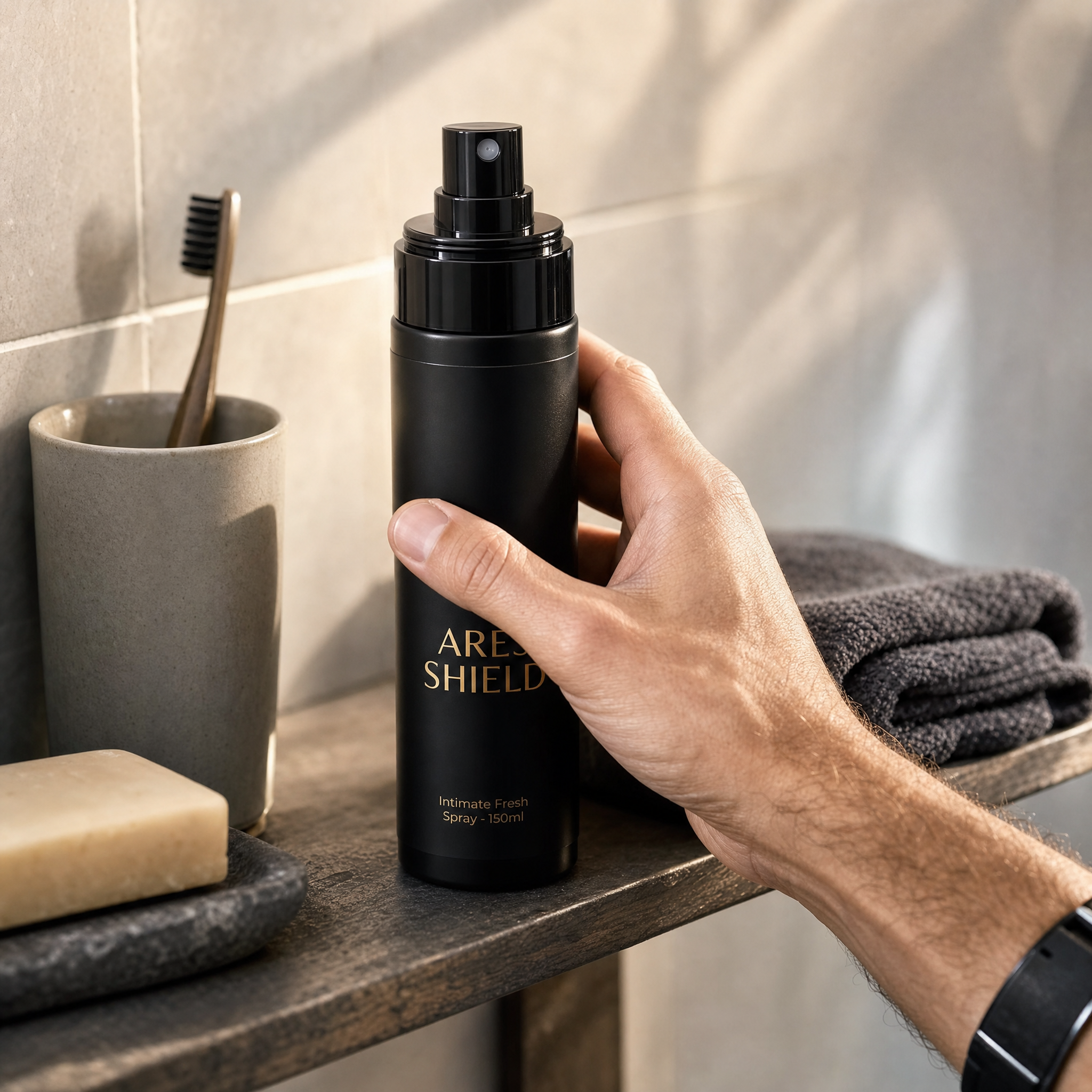
What worked was different in kind, not degree. Not a cover-up a skin-care-grade spray, applied in five seconds, that goes after the three conditions themselves: it breaks the trapped heat on contact (a real cooling response, the same nerve receptors that make menthol feel cold), it draws out the sealed-in moisture the bacteria feed on, and it targets the odor-causing bacteria the source, not the scent. Then it leaves the skin calmer than it found it, instead of stripped raw the way harsh products do.
One spray. Folded into the shower routine he already has. Shower, spray, go. No new habit for him to remember. Nothing for him to notice except the difference.
And this is the part that surprised me most in every follow-up conversation:
Not one of these women had "the conversation."
They didn't sit him down. They didn't hunt for the perfect gentle words. Most had rehearsed that talk a hundred times in their heads and watched every imagined version end badly because they'd read the same threads I have. The woman who said it as lovingly as it can possibly be said and still heard "I'm traumatized, it's over." The one whose gentle attempt was "met with passive aggressiveness." The ones whose partner never touched them quite the same way again.
So instead, a bottle simply appeared on his shelf. Next to his deodorant. It looks like any other men's grooming product nothing on it announces what it's for. He assumed it was his, and he used it. He never asked. She never had to explain. There was nothing to explain.
And here is what she got in return described in nearly identical words across the group: within a couple of weeks, the dread was gone. The bracing was gone. The little held breath was gone. And in its place, slowly, something she thought she'd lost reaching for him again. Wanting to. The way she did at the very start.
He has no idea any of it happened. He never spent one night feeling like less of a man. He just thinks he got lucky lately. He keeps every ounce of his confidence and she got the two of them back. Nobody had to lose anything for that to be true.
The part I most want you to hear
If you're reading this and recognizing yourself, there's one thing this work made painfully clear, and I'd be doing you a disservice not to say it plainly.
There is a window. It doesn't stay open.
The women who caught this early while it was still just a smell, a physical thing with a physical fix — got their intimacy back almost completely. The women who waited, who spent years breathing through their mouths and telling themselves it didn't matter, described something harder to reverse: the point where the dread stops being about the smell and becomes about him. Where the body's flinch turns into a distance you can no longer explain to him, or to yourself. Past that point, it isn't a smell you're fixing anymore. It's a marriage.
The difference between those two outcomes was never how much they loved their partner. It was how early they understood what was actually happening and how simply they acted while it was still simple.
If he smelled good when you met, and something changed, and you've been quietly carrying it ever since: it was never your fault, and it was never his. It's the box. And the box has a fix that takes five seconds a day and requires no conversation at all.
You don't have to just deal with it. And you don't have to break his heart to change it.
There's a third option and it comes with a 30-day money-back guarantee, so the only thing you're risking is another year of holding your breath.
Methodology: survey of 753 women in committed relationships, conducted Feb 5 in collaboration with editor Emma Laurent. Forum quotations are drawn from public posts on Reddit and Quora, lightly edited for length.
This article reflects survey responses and public accounts and is written for general information. It describes a cosmetic comfort product, not a medical treatment. If odor is persistent or accompanied by other symptoms, a doctor should be consulted.